
Rabby browser wallet: What DeFi power users get right — and what they often misunderstand
What if the single most important feature in a wallet for active DeFi users isn't custody or a flashy UI, but the ability to show you exactly what will happen before you hit “Sign”? That question reframes how you evaluate Rabby, a non-custodial, multi-chain wallet built by DeBank that has steadily positioned itself for people who trade, bridge, and compose complex transactions across many EVM chains. Rabby’s transaction simulation and risk-scanning are not marketing flourishes; they are mechanism-level defenses against a common failure mode in DeFi: blind signing.
This piece is a myth-busting look at Rabby aimed at experienced DeFi users in the US who need a secure, composable client. I’ll explain how Rabby’s core features work, where they materially reduce risk, what they cannot protect you from, and the practical trade-offs when you compare Rabby to other wallets. I’ll also walk through decision heuristics you can reuse when choosing a wallet for sophisticated DeFi activity.
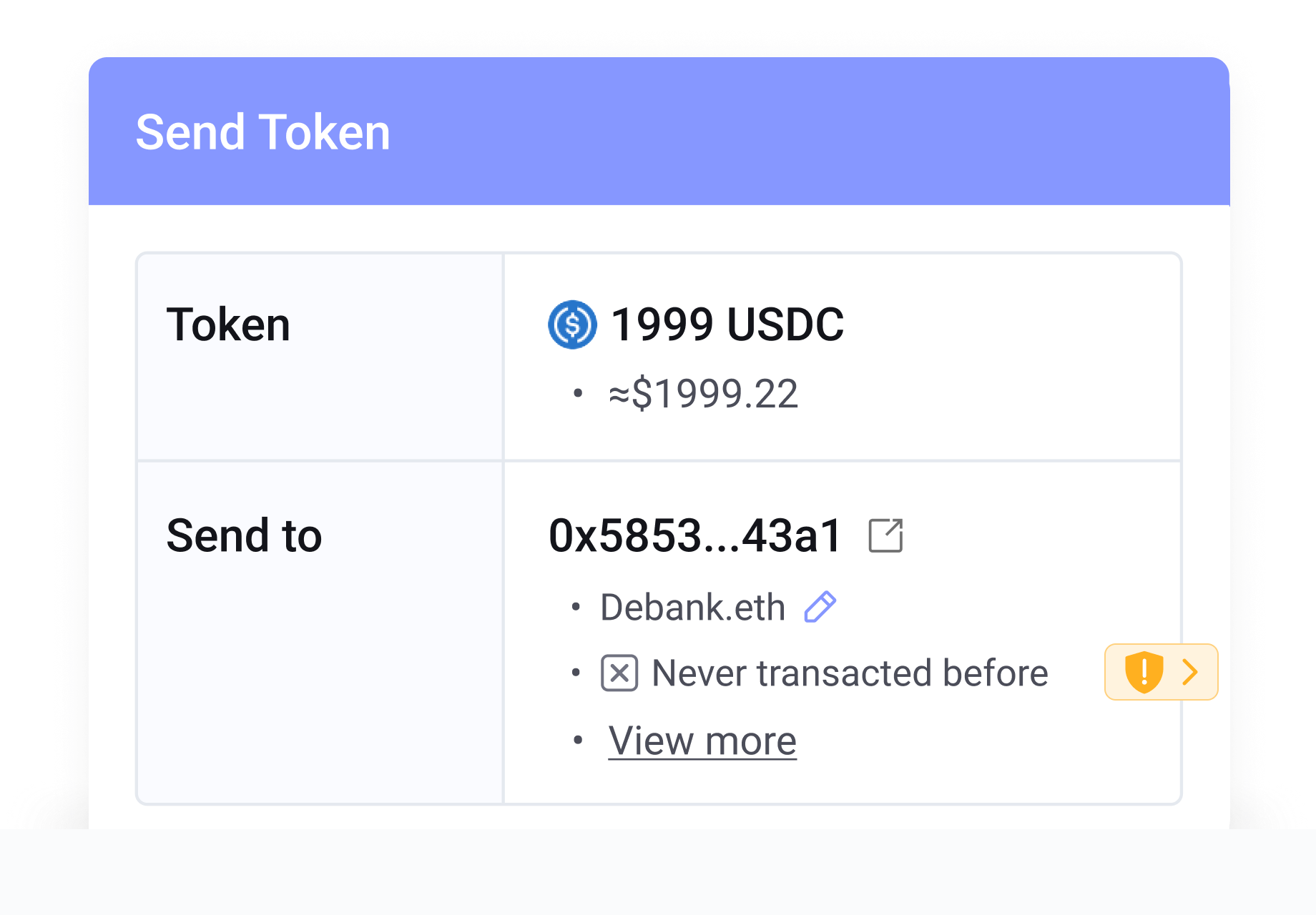
Mechanism first: how Rabby reduces ‘blind signing’ and what that actually buys you
Rabby’s defining technical claim is transaction simulation: before signing, the extension runs the transaction locally and displays estimated token balance changes and exact fee costs. Mechanically, this is a pre-execution step that reconstructs the on-chain state changes the signed call would produce, then surfaces the deltas (token amounts in/out, approvals consumed, ETH or gas spent). That matters because many wallet compromises are neither infrastructure breaks nor private-key leaks but user errors induced by opaque approvals or UI trickery in dApps.
Complementing simulation, Rabby runs a pre-transaction risk scan. It flags things such as interactions with addresses marked as previously exploited, unusually broad token approvals, or transfers to obviously invalid recipients. In practice that combination turns a binary “approve” decision into a small forensic exercise: you now see the expected numeric outcome and a short list of risk signals. For an active trader or liquidity provider moving funds across 90+ EVM chains, those signals materially reduce the probability of accidental, irreversible losses from approving malicious contracts.
Common myth #1 — “Simulations are perfect; if it shows green, you’re safe”
Reality: simulations are powerful but not infallible. They operate against the on-chain state the simulator can observe and assumptions about contract logic. If a contract uses oracles with delayed updates, or relies on off-chain components that change between simulation and execution, the simulated outcome may differ. Similarly, a sophisticated attacker could craft a multi-step exploit that checks for simulation patterns or causes state changes between the simulation and actual execution. So treat simulation as a major reduction in risk, not an absolute guarantee.
Decision rule: use simulation as a filter that separates routine, low-risk calls from ones that require extra verification (manual code review, hardware-wallet signing, or splitting the approval amount). If simulation flags an unfamiliar large token outflow or a full-approval, pause and investigate — even if the UI looks legitimate.
Where Rabby stands out — and where it still hands the baton to best practices
Distinctive strengths:
- Transaction simulation plus explicit balance deltas: reduces blind-signing mistakes more than a simple textual warning.
- Wide multi-chain coverage (90+ EVM chains): helpful for traders and yield farmers who hop chains instead of staying on Ethereum mainnet.
- Hardware wallet integrations and institutional hooks (Gnosis Safe, Fireblocks): enables stronger custody models and multi-sig workflows for teams or funds.
- Native approval revocation and cross-chain gas top-up: practical tools for minimizing long-tail approvals and for moving gas to chains where you need to transact.
Limitations that matter to advanced users:
- No built-in fiat on-ramp. If you need USD-to-crypto routing inside the wallet, you’ll rely on third-party services and extra steps.
- No native in-wallet staking. For certain DeFi strategies, that means managing staking through dApp interfaces or external platforms.
- Simulations cannot replace hardware security or operational hygiene. They complement, not substitute, cold storage and granular approval habits.
Myth #2 — “An open-source wallet means security is solved”
Open-source code under MIT is valuable because it allows independent audits and community review. But security is a process, not a label. Rabby’s open-source status combined with past response behavior is instructive: in 2022 a Rabby Swap contract was exploited for about $190,000; the team froze the contract, compensated users, and hardened audits afterward. That episode shows that even teams with good intentions and open code can suffer design or integration flaws. The useful mental model is to treat open-source as lowering the barrier for detection and remediation, not as a guarantee of bug-free operations.
Practical implication: for high-value operations, combine Rabby’s open-source transparency with layered defenses — hardware signing, multi-sig for treasury-level funds, and approval minimization for protocols you don’t fully trust.
Comparative trade-offs: Rabby vs MetaMask, Trust Wallet, Coinbase Wallet
Rabby’s positioning is pragmatic: it competes not on brand ubiquity but on transaction safety features. Compared with MetaMask, Rabby’s simulation and automatic network switching reduce user friction and risky manual steps. Against Trust Wallet and Coinbase Wallet, Rabby favors DeFi tooling (approval revocations, portfolio aggregation across many chains) rather than fiat on-ramps or custodial conveniences.
Trade-off heuristic: if your activity pattern is frequent approvals, complex interactions, and cross-chain routing, Rabby’s tooling likely reduces operational risk. If your priority is buying crypto with USD inside the wallet or very deep integration with a CEX, those other wallets may be more convenient.
Practical checklist for power users who install the rabby wallet extension
Install and onboarding tips that reduce exposure:
- Pair Rabby with a hardware wallet for any account that holds significant funds. Rabby supports Ledger, Trezor, Keystone, and others.
- Use Rabby’s approval revocation routinely after interacting with unfamiliar contracts — small habit, big reduction in long-tail risk.
- Rely on simulation as your first line of defense; if the simulated deltas or fees don’t match expectations, pause and verify on the dApp or contract code level.
- For institutional flows, prefer multi-sig integrations (Gnosis Safe) and custody providers (Fireblocks) connected through Rabby rather than single-signer setups.
If you want to try the browser extension, a natural place to start is the official installation page for the rabby wallet extension, and then immediately connect it to a hardware device or a test account to validate behavior before moving significant funds.
Where Rabby could matter next — conditional scenarios and signals to watch
Three conditional scenarios where Rabby’s design choices produce outsized value:
- If DeFi composability continues to push more multi-step, cross-chain transactions into single UX flows, Rabby-style transaction simulation will become a baseline expectation, not a niche feature.
- If fiat on-ramps remain concentrated in centralized exchanges, wallets that do not add native fiat may retain a security advantage — fewer integrated touchpoints mean fewer attack surfaces — but they will be less convenient for new entrants.
- If institutional adoption rises and treasury workflows require programmatic safety checks, Rabby’s multi-sig and custody integrations could make it a common client for funds that need both convenience and auditability.
Signals to monitor: expansion in hardware-wallet APIs, any further security incidents with wallet-linked dApps, and whether major bridges begin to require more expressive pre-execution checks that push wallets to standardize simulations.
FAQ
Does Rabby prevent all smart-contract exploits?
No. Rabby reduces user-level risks (blind approvals, accidental transfers, interacting with known-bad addresses) through simulation and scanning. It cannot stop contract-level bugs, oracle manipulation, or exploits that occur after the simulation. Use hardware wallets, multi-sig for large balances, and limit approvals to mitigate residual risk.
Can I use Rabby with my Ledger or Trezor?
Yes. Rabby supports a wide range of hardware wallets — Ledger, Trezor, Keystone, CoolWallet, GridPlus, and BitBox02 among them — and pairing a hardware device is one of the fastest ways to improve your operational security.
How reliable are the transaction simulations across different chains?
Simulations are generally reliable for EVM-compatible chains because they reproduce on-chain state changes deterministically. However, edge cases exist: contracts that depend on off-chain data, timing-sensitive oracle updates, or race conditions between simulation and execution can cause differences. Treat simulation as a strong but not absolute indicator.
Is Rabby a good choice for institutional users?
Rabby integrates with Gnosis Safe and custodial services like Fireblocks and Amber, which makes it suitable as a front-end for institutional workflows. For treasury security, pair Rabby with multi-sig, audited contracts, and custodial providers rather than relying on a single signer.
Bottom line: Rabby reframes the wallet from a static key manager to an active transaction auditor. For a US-based DeFi power user who routinely composes cross-chain trades, liquidity ops, and approvals, that reframing matters — but it does not remove the need for layered security. Treat simulation and revocation tools as powerful controls in a broader operational playbook: hardware signing, multi-sig for high-value funds, minimal approvals, and a routine of skeptical verification before any unusually large or unfamiliar interaction.